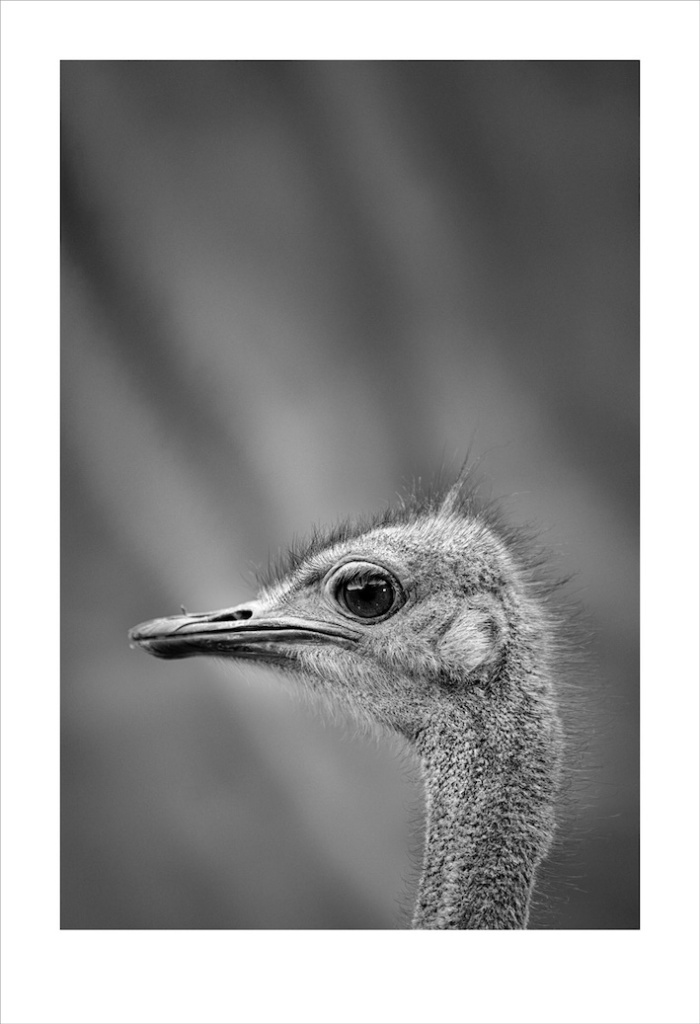

Ostrich Offs
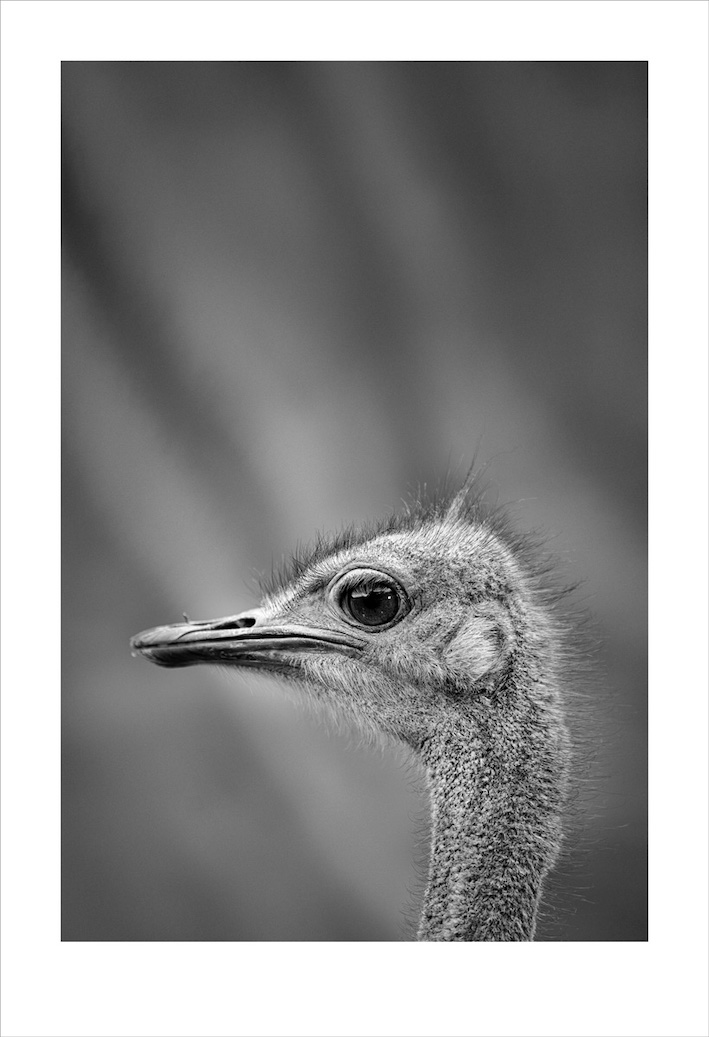
Look Left
| Medium | Photograhy Archival pigment ink on Baryta |
| Dimensions | "17.3" x 23.1" |
| Edition Size | 10 |
| Value | $550.00 |
Story of this Series
+
This section exemplifies a core principle of a Scatter Methodology that requires continually circling back to the governing questions and revising methods of inquiry as needed in order to get closer to the heart of the matter — in order to understand better. In this case, the main finding from the previous section was unsettling. Even though I had followed industry standards for animal representation, I felt I had crossed an ethical line. And, The Ostrich Portraits also felt incomplete. What, if anything, could rise from the ashes of the Ostrich Portrait series? I took approximately 300 photographs, 98% of them were unusable. The discarded photographs—of which only twelve comprise this series, depict an ostrich reality that is entirely absent from the portraits. They represent a clash, between what I wanted — a portrait, and what the ostrich wanted— to get away from me. The images in this series reside along a spectrum of ostrich representation. At the far end of this new spectrum of ostrich representation are the least acceptable images — those that are completely out of focus. They were unintentionally out of focus and yet the blurry images compel a different kind of image contemplation. For example, they invite active participation in the meaning-making process of reading the photograph since its content is literally and figuratively unclear. More importantly, these images reveal what the ostrich is interested in: eluding capture— both technological and physical. Some of the images near the unacceptable end of the spectrum are experiments in aperture. The shallow depth of field resulted in images with a focus on specific details of the ostrich like a nasal cavity or the eyelashes of an upper eyelid. These contrast sharply with the normative standards in the practice of wildlife photography which require the animal to be mostly in focus. In the middle of the spectrum are images that are in focus but that diverge from conventional ways wildlife subjects are typically presented. A photograph of the back of a neck or an ostrich looking away from the camera, may reflect an ostrich choosing to look at something besides the photographer. Partial images where only an eye or part of a beak is visible— imply a larger body just beyond the frame. These photographs hint at the subject’s capacity to live beyond the confines of representation, whereas traditional portraits tend to isolate or reduce the animal to what is visible within the frame. The photograph of a tattooed hand gently holding/guiding an ostrich neck is an example sits at the nearly acceptable end of the spectrum. It is in focus, compositionally balanced, but importantly, also includes a reference to the human elements that facilitated it’s [the photograph’s] production. Portraits are typically a slice of a subjectivity that also displays a technical expertise with an authoritative air. What about an Off? The Offs possess a different kind of power. An Off is more “open” to interpretation not only because the images are blurred and a viewer must imagine activity and context. And not only because an animal is partly in the frame and a viewer may assume that life happens outside of it. It is more open because the language for reading an Off is less well defined. The controlling order with which language structures any representation is loosened when it is not shared. In this more fuzzy form, there may be more room for collaboration between the spectator and the image in the reading and subsequent meaning-making. It could be that the language of reading “offs” is a hybrid animal-human communication. Just as the technical deficiency of the instant film cameras became cause for aesthetic celebration, a reading of the Off’s could borrow from the visio-cultural language of lomography. What was captured at Cornellskop, Bot River, on the day of my ostrich shoot went well beyond the intended portraits of individual ostrich and included what it looks like when ostrich try to get away from the lights, cameras, and action. That the ostrich had desires isn’t surprising. Nor is it surprising that those desires were practically and visibly in conflict with my own. What surprised me was the artistic result of using photography as a research tool to explore this question: Do we need to see an animal as an individual in order to care about it? The Ostrich Offs express ostrich differently. They stretch the spectrum of representation by presenting ostrich with agency. I don’t purport to know, nor can I ever know the lived experience of an ostrich. But the Offs became a way to indicate it — which I’m almost certain is better than continuing to represent ostriches as if it [agency] doesn’t exist. The Offs point to an ethics of representation both in process and in product. I believe there is great potential in representation that depicts animal agency even if it is at the expense of a human desire to represent and or to know.