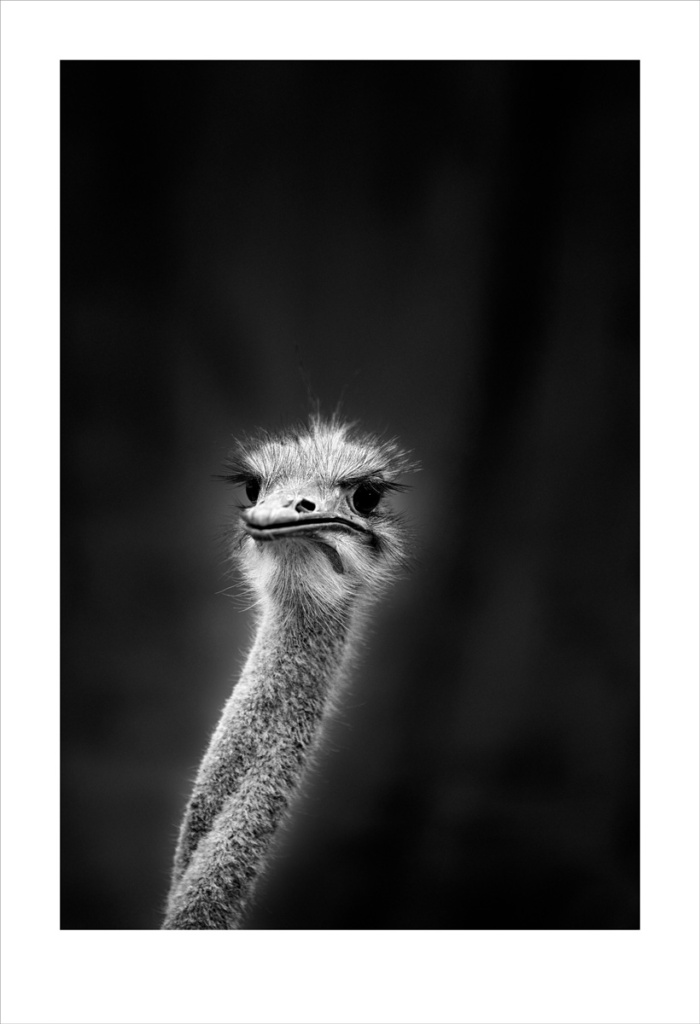

Ostrich Portraits
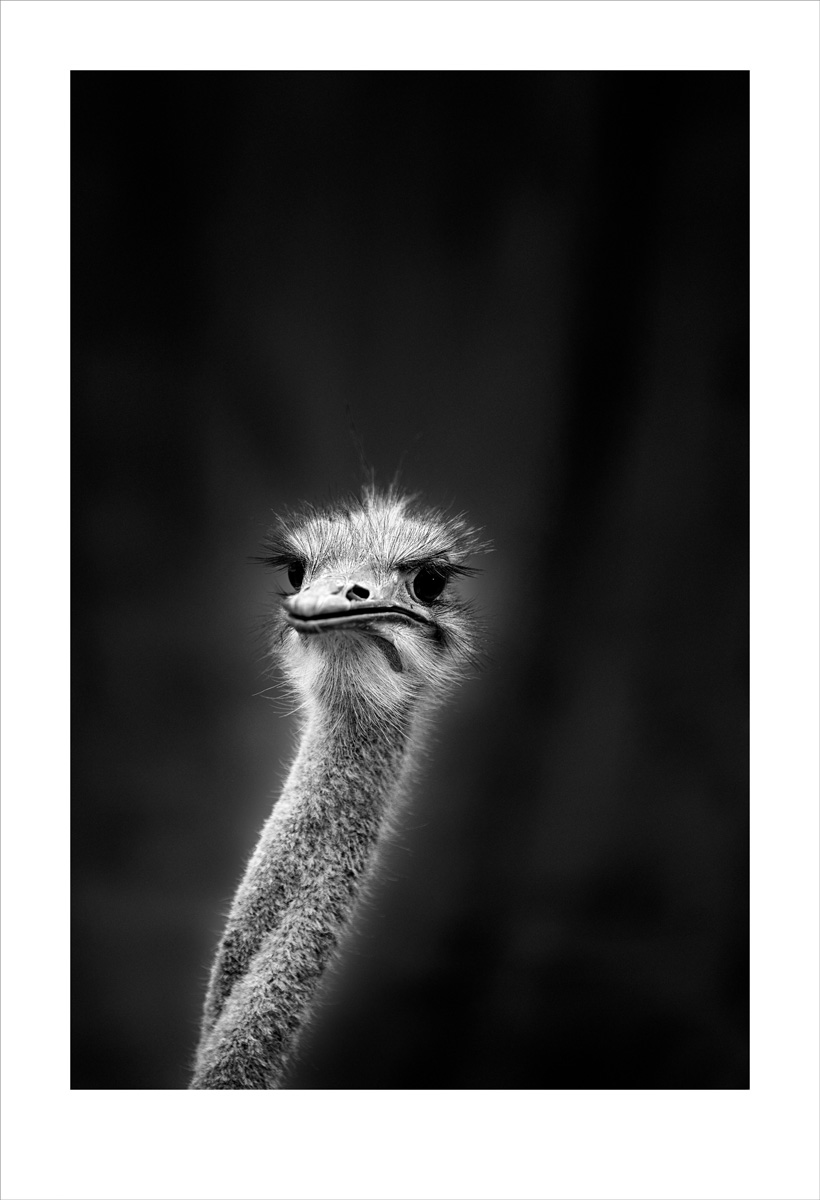
Bakkie
| Medium | Photograhy Archival pigment ink on Baryta |
| Dimensions | 17.3” x 23.1” |
| Edition Size | 10 |
| Value | $550.00 |
Story of this Series
+
This series began alongside work I was doing on the subject of roadkill—an exploration of how we so casually pass dead animals on the road without pause. Do we need to see an animal as an individual in order to care? That question led me to begin with portraits. Portraiture felt like the right approach—it naturally invites viewers to notice the nuances of a subject: physical traits, personality, mood, and more. If individual animals were to be seen at all, portraiture, I believed, was the way to make them visible. I decided to focus on twelve ostriches. But could I actually distinguish between them? They looked so alike. The shoot took place at Cornellskop, a working animal farm north of Cape Town, owned by Luke Cornell—a veteran of the animal representation world. Of the more than 100 sanctuaries I’ve visited across Canada, the U.S., Namibia, South Africa, Kenya, Tanzania, Zimbabwe, and Zambia, Cornellskop stands out as one of the top five in terms of ethical standards. The Shoot. Every time an animal is photographed there is a context in which the act takes place —one that’s often overlooked or ignored. On the day of the shoot, clouds loomed overhead. The indoor "controlled environment" setup I had planned required more lighting—and more budget—than I had. So I adapted. I set up an eight-foot rig with a backdrop and a single fill light near an enclosure that housed a flock of rescued ostriches. Luke opened the pasture gate, and the birds immediately began walking toward him. Though they had an acre to roam, they chose to come to Luke. It was a promising start. But things quickly unraveled. Luke and three handlers tried to coax the ostriches through the gate and toward my makeshift studio. The birds were having none of it. We called to them, mimicked their sounds, gestured gently, tried to lure them with calm movements. I reinforced the backdrop to stop it flapping in the breeze. I laid a not-so-subtle trail of food from the pasture to the set. But they refused to be tricked. The ostriches wanted absolutely nothing to do with me. More handlers were summoned. A pickup truck arrived carrying 116 feet of fencing. Within minutes, a corral was fashioned: a funnel from pasture to holding pen to a narrow passage just wide enough to guide one ostrich at a time to the mark. Luke and the crew moved in a slow lateral sweep, arms wide, to gently herd the birds toward the corral entrance. I set my camera to high-speed continuous shooting. I was ready. Once on set, each ostrich stayed for only seconds. I scrambled to get a portrait while the bird scrambled to escape. The most dramatic moment came with Jesus, the only male in the group. He was nearly nine feet tall, close to 300 pounds, and, frankly, magnificent. Ostriches can run up to 70 miles an hour, their toes can disembowel a predator—or a person and their kicks can kill. Jesus lingered at the gate, clearly reluctant. He needed a bit of encouragement. A canvas sack was gently placed over his head, and he was guided into the corral, where Bella, a camera veteran, waited calmly. The moment the sack came off, Jesus bolted. He flailed and darted with extraordinary energy, destroying my set and crashing through the fencing, bringing the entire corral down with him. The shoot was over. Interestingly, Jesus didn’t run far. In fact, there he stood grazing peacefully alongside Bella and Mäkovél, just a stone’s throw from the disaster zone. That felt like a good sign. Despite their clear dislike of the shoot—the set, the backdrop, my presence, my scent—the ostriches didn’t seem disturbed by the place itself. In the end, six portraits were more than enough. Reflections. Each portrait in the series features a plain black background. And yes, if you look closely—at neck markings, nasal openings, beak shapes, the texture of crown feathers, the slope of a skull— you can absolutely tell them apart. They're in focus, centred, and staring straight into the lens. The original question—can we recognize individual ostriches from their portraits?—was answered quickly. Yes. What felt more revealing, though, was the answer to a question I hadn’t consciously asked. The process of creating these portraits changed the way I see them. I had intended to evoke empathy by showing individuality. But all I felt was shame for what I put the animals through in pursuit of that idea. I was reminded of White Wolf (1987), a National Geographic and Chevron film. In it, a filmmaker crosses the threshold of a wolf den, entering the private space of a mother and her cubs, despite the mother’s clear distress. Even after voicing admiration for her, the scientist prioritized knowledge over empathy. And here I was, decades later, doing the same thing. In my desire to reveal the ostriches as individuals, I disregarded how they might feel. I let the pursuit of representation—of "knowing"—override every other consideration. Like the filmmakers in White Wolf , I crossed a line and claimed the representational space as my own. What I took from this project is simple, perhaps obvious: an ethics of representation must be at the center of any act of depiction. One of the methods I chose from Scatter Methodology involves physically sitting in a specific place. But after Ostrich Portraits, I chose instead to sit with my feelings. It was during this period of unease that the idea for my next series, Ostrich Offs, was born.